Acrylic-Based Gel-Type & Macroporous Weak Acid Cation Exchange Resins
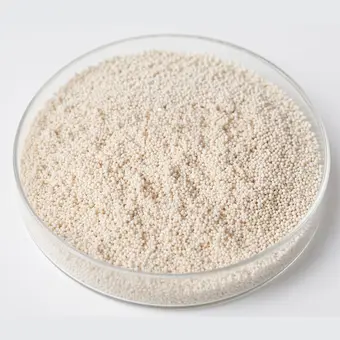
Ultra-high capacity carboxylic acid weak acid cation resins (≥10.8 mmol/g) including D113 for high-bicarbonate water dealkalization and softening, 112 for drinking water cartridges, and methacrylic PXD-110 / PXD-111 / PXD-112 for Vitamin B12 and colistin sulfate extraction.
Polymer Architecture & Functional Chemistry Profile
Cation Exchange Resin · 7 Standardized & Specialty GradesGrade-by-Grade Technical Parameter Table
Click any grade code or TDS button to open its individual printable Technical Data Sheet, or click + RFQ to add multiple grades to your inquiry basket.
⇄ Swipe horizontally to inspect all technical parameters
Acrylic-Based Gel-Type & Macroporous Weak Acid Cation Exchange Resins — Physical & Chemical Specifications
R–COO⁻ · Acrylic / Methacrylic · Gel & Macroporous · 7 Grades| Grade | Ionic Form | Total Capacity (mmol/g) | Volume Capacity (mmol/mL) | Water Retention (%) | Bulk Density (g/mL) | Specific Gravity (g/mL) | Particle Size Range (%) | Effective Size (mm) | Uniformity Coeff. | Whole Bead After Attrition (%) | Reversible Swelling | Color | Applications & Technical Remarks | TDS / RFQ |
|---|---|---|---|---|---|---|---|---|---|---|---|---|---|---|
| 112 | H⁺ | ≥10 | – | 40–50 | 0.72–0.82 | 1.15–1.25 | 0.315–1.25 mm ≥95 | 0.4–0.7 | ≤1.6 | (≥90) | H⁺ -> Na⁺ ≤105% | Light yellow | Gel-type acrylic weak acid resin with good mechanical strength and no oligomer agglomeration; mainly used for pharmaceutical extraction and drinking water softening | |
| D113 | H⁺ | ≥10.8 | 4.4 | 45–52 | 0.72–0.8 | 1.14–1.20 | 0.315–1.25 mm ≥95 | 0.4–0.7 | ≤1.6 | ≥95 | H⁺ -> Na⁺ ≤70% | Light yellow | Excellent resistance to oxidation, physical breakage, osmotic shock and organic fouling, with high working capacity (4.4 mmol/mL); widely used for water softening and dealkalization. FC grade for floating beds, SC grade for double-layer beds | |
| D113FC | H⁺ | ≥10.8 | 4.4 | 45–52 | 0.72–0.8 | 1.14–1.20 | 0.45–1.25 mm ≥95 | ≥0.5 | ≤1.6 | ≥95 | H⁺ -> Na⁺ ≤70% | Light yellow | Floating-bed grade macroporous acrylic weak acid cation resin | |
| D113SC | H⁺ | ≥10.8 | 4.4 | 45–52 | 0.72–0.8 | 1.14–1.20 | 0.315–0.63 mm ≥95 | 0.35–0.5 | ≤1.4 | ≥95 | H⁺ -> Na⁺ ≤70% | Light yellow | Double-layer bed upper-layer grade paired with 002SC or D001SC | |
| PXD-110 PURIONX | H⁺ | ≥10.5 | – | 50–60 | 0.7–0.8 | 1.10–1.20 | 0.315–1.25 mm ≥95 | 0.4–0.7 | ≤1.6 | ≥90 | H⁺ -> Na⁺ ≤100% | White | Methacrylic acid-based weak acid resin with excellent organic fouling resistance; mainly used for Vitamin B12 extraction | |
| PXD-111 PURIONX | H⁺ | ≥10 | – | 55–65 | 0.7–0.8 | 1.10–1.20 | 0.315–1.25 mm ≥95 | 0.4–0.7 | ≤1.6 | ≥90 | H⁺ -> Na⁺ ≤100% | White | Higher-moisture methacrylic acid-based weak acid resin with excellent organic fouling resistance; mainly used for Vitamin B12 extraction | |
| PXD-112 PURIONX | H⁺ | ≥10.5 | ≥3.5 | 50–60 | 0.7–0.8 | 1.10–1.20 | 0.315–1.25 mm ≥95 | 0.4–0.7 | ≤1.6 | ≥90 | H⁺ -> Na⁺ ≤100% | White | Mainly used for the extraction and separation of colistin sulfate, with high selectivity and easy elution |
Comparable International Brand Grades (Acrylic Weak Acid Cation (WAC))
Reference equivalents from Purolite, Dowex, Amberlite, Lewatit, Diaion, Duolite, and ResinTech based on matrix structure, functional group, and exchange capacity.
⇄ Swipe horizontally to compare all 9 international resin brands
Acrylic Weak Acid Cation (WAC) — International Brand Cross-Reference
PURIONX vs. Purolite · Dowex · Amberlite · Lewatit · Diaion · Duolite · ResinTech · Ion Plus · GOST| PURIONX Grade | Resin Type | Purolite | Dowex | Amberlite | Lewatit | Diaion | Duolite | ResinTech | Ion Plus | GOST | Action |
|---|---|---|---|---|---|---|---|---|---|---|---|
| 112 | Gel Acrylic WAC | C105 | – | IRC-86 | – | – | – | – | – | – | |
| D113 | Macroporous Acrylic WAC | C104E | MWC-1 | IRC76 / 84 / 86 | CNP-80 | WK-40 | – | WACMP | CA-15 | K5-4 |
Need a Technical Quotation, Batch COA, or 500 mL Evaluation Sample?
Specify your target resin grade (or competitor model), vessel volume, and destination port. Our engineering team responds with a formal quotation, batch COA, and sample dispatch terms.