
Styrene-Based Macroporous Strong Base Anion Exchange Resin (Type I, II & Specialty)
Macroporous Type I (D201), Type II (D202-Ⅱ), and specialty macroporous strong base anion resins (D299 organic scavenger, D299-Ⅱ food decolorizer, D298 heparin sodium extraction, D203 selective nitrate/nitrite removal).
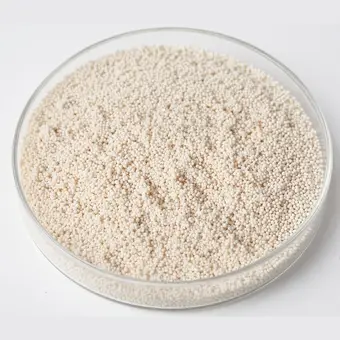
Polymer Architecture & Functional Chemistry Profile
Anion Exchange Resin · 14 Standardized & Specialty Grades- D201 (Cl⁻)
- D201 (OH⁻)
- D201FC
- D201SC
- D201MB
- D201TR
- D202-Ⅱ (Cl⁻)
- D202-Ⅱ (OH⁻)
- D202-ⅡFC
- D202-ⅡSC
- D299
- D299-Ⅱ
- D298
- D203
Custom Screening & Ionic Conversion: High anti-fouling pore structure resists humic/fulvic organic poisoning while maintaining superior mechanical integrity.
Grade-by-Grade Technical Parameter Table
Click any grade code or TDS button to open its individual printable Technical Data Sheet, or click + RFQ to add multiple grades to your inquiry basket.
⇄ Swipe horizontally to inspect all technical parameters
Styrene-Based Macroporous Strong Base Anion Exchange Resin (Type I, II & Specialty) — Physical & Chemical Specifications
R–N⁺R₃ (MP) · Styrene-DVB · Macroporous · 14 Grades| Grade | Ionic Form | Strong-Base Capacity (mmol/g) | Volume Capacity (mmol/mL) | Water Retention (%) | Bulk Density (g/mL) | Specific Gravity (g/mL) | Particle Size Range (%) | Effective Size (mm) | Uniformity Coeff. | Whole Bead After Attrition (%) | Reversible Swelling | Color | Applications & Technical Remarks | TDS / RFQ |
|---|---|---|---|---|---|---|---|---|---|---|---|---|---|---|
| D201 (Cl⁻) | Cl⁻ | ≥3.7 | ≥1.20 | 50–60 | 0.65–0.73 | 1.06–1.10 | 0.315–1.25 mm ≥95 | 0.4–0.7 | ≤1.6 | ≥90 | Cl⁻ -> OH⁻ ≤20% | White to light yellow | Excellent resistance to physical breakage and osmotic shock, plus good silica removal. Mainly used for demineralization; can also be used to adsorb gold from cyanide ore pulp | |
| D201 (OH⁻) | OH⁻ | ≥3.8 (4.0) | ≥1.00 | 55–65 | 0.63–0.70 | 1.05–1.08 | 0.315–1.25 mm ≥95 | 0.4–0.7 | ≤1.6 | ≥90 | Cl⁻ -> OH⁻ ≤20% | White to light yellow | Pre-regenerated OH⁻ form of D201 macroporous strong base anion resin | |
| D201FC | Cl⁻ | ≥3.7 | ≥1.20 | 50–60 | 0.65–0.73 | 1.06–1.10 | 0.45–1.25 mm ≥95 | ≥0.5 | ≤1.4 | ≥90 | Cl⁻ -> OH⁻ ≤20% | White to light yellow | Floating-bed grade macroporous Type I strong base anion resin | |
| D201SC | Cl⁻ | ≥3.7 | ≥1.10 | 50–60 | 0.65–0.73 | 1.06–1.10 | 0.63–1.25 mm ≥95 | ≥0.63 | ≤1.4 | ≥90 | Cl⁻ -> OH⁻ ≤20% | White to light yellow | Double-layer bed grade macroporous Type I strong base anion resin | |
| D201MB | Cl⁻ | ≥3.7 | ≥1.20 | 50–60 | 0.65–0.73 | 1.06–1.10 | 0.4–0.9 mm ≥95 | 0.5–0.8 | ≤1.4 | ≥90 | Cl⁻ -> OH⁻ ≤20% | White to light yellow | Mixed-bed grade macroporous Type I strong base anion resin paired with D001MB | |
| D201TR | Cl⁻ | ≥3.7 | ≥1.20 | 50–60 | 0.65–0.73 | 1.06–1.10 | 0.4–0.9 mm ≥95 | 0.5–0.8 | ≤1.4 | ≥90 | Cl⁻ -> OH⁻ | White to light yellow | Macroporous strong base resin for tri-layered beds; used together with D001TR and S-TR | |
| D202-Ⅱ (Cl⁻) | Cl⁻ | ≥3.4 | ≥1.20 | 47–57 | 0.68–0.74 | 1.07–1.12 | 0.315–1.25 mm ≥95 | 0.4–0.7 | ≤1.6 | ≥90 | Cl⁻ -> OH⁻ ≤15% | White to light yellow | Macroporous Type II strong base anion resin with excellent resistance to physical breakage and osmotic shock and very high working capacity. FC grade for floating beds, SC grade for double-layer beds | |
| D202-Ⅱ (OH⁻) | OH⁻ | ≥3.5 (3.7) | ≥1.00 | 50–60 | 0.67–0.72 | 1.06–1.10 | 0.315–1.25 mm ≥95 | 0.4–0.7 | ≤1.6 | ≥90 | Cl⁻ -> OH⁻ ≤15% | White to light yellow | Hydroxide-form Type II macroporous strong base anion resin | |
| D202-ⅡFC | Cl⁻ | ≥3.4 | ≥1.15 | 47–57 | 0.68–0.74 | 1.07–1.12 | 0.45–1.25 mm ≥95 | ≥0.5 | ≤1.4 | ≥90 | Cl⁻ -> OH⁻ ≤15% | White to light yellow | Floating-bed grade Type II macroporous strong base anion resin | |
| D202-ⅡSC | Cl⁻ | ≥3.4 | ≥1.20 | 47–57 | 0.68–0.74 | 1.07–1.12 | 0.63–1.25 mm ≥95 | ≥0.63 | ≤1.4 | ≥90 | Cl⁻ -> OH⁻ ≤15% | White to light yellow | Double-layer bed grade Type II macroporous strong base anion resin | |
| D299 | Cl⁻ | ≥3.5 | ≥1.10 | 50–60 | 0.65–0.75 | 1.05–1.10 | 0.315–1.25 mm ≥95 | 0.4–0.7 | ≤1.6 | ≥90 | Cl⁻ -> OH⁻ ≤20% | White to light yellow | Very high resistance to organic fouling; mainly used as an organic scavenger and sugar decolorizer | |
| D299-Ⅱ | Cl⁻ | ≥3.8 | ≥0.80 | 55–65 | 0.63–0.73 | 1.03–1.08 | 0.315–1.25 mm ≥95 | 0.4–0.7 | ≤1.6 | ≥90 | Cl⁻ -> OH⁻ ≤20% | White to light yellow | Same family as D299 but specifically tailored for food and sugar processing, with stronger color-body removal | |
| D298 | Cl⁻ | ≥3.5 | ≥0.55 | 70–85 | 0.60–0.70 | 1.04–1.08 | 0.315–1.25 mm ≥95 | 0.4–0.7 | ≤1.6 | ≥90 | Cl⁻ -> OH⁻ ≤25% | White to light yellow | High-moisture large-pore dedicated resin for heparin sodium extraction | |
| D203 | Cl⁻ | ≥2.9 | ≥0.90 | 48–58 | 0.66–0.72 | 1.06–1.10 | 0.315–1.25 mm ≥95 | 0.4–0.7 | ≤1.6 | ≥90 | Cl⁻ -> OH⁻ ≤20% | White to light yellow | High selectivity for the removal of nitrate (NO₃⁻) and nitrite (NO₂⁻) from aqueous solutions, reducing total chlorine content |
Comparable International Brand Grades (Macroporous Strong Base Anion)
Reference equivalents from Purolite, Dowex, Amberlite, Lewatit, Diaion, Duolite, and ResinTech based on matrix structure, functional group, and exchange capacity.
⇄ Swipe horizontally to compare all 9 international resin brands
Macroporous Strong Base Anion — International Brand Cross-Reference
PURIONX vs. Purolite · Dowex · Amberlite · Lewatit · Diaion · Duolite · ResinTech · Ion Plus · GOST| PURIONX Grade | Resin Type | Purolite | Dowex | Amberlite | Lewatit | Diaion | Duolite | ResinTech | Ion Plus | GOST | Action |
|---|---|---|---|---|---|---|---|---|---|---|---|
| D201 | Macroporous Type I SBA | A500 | MSA-1 | IRA900 | MP500 | PA308 / 312 | A-161 | SBMP 1 | AN-23 | AB-17-10n | |
| D299 | Macroporous Organic Scavenger | – | MSA | IRA910 / 904 | MP500A | – | – | SBG-1VP | – | – | |
| D201MB | Macroporous SBA (MB) | A500DL | – | – | – | – | – | – | – | – | |
| D201TR | Macroporous SBA (Tri-Bed) | A500TL | – | – | – | – | – | – | – | – |
Need a Technical Quotation, Batch COA, or 500 mL Evaluation Sample?
Specify your target resin grade (or competitor model), vessel volume, and destination port. Our engineering team responds with a formal quotation, batch COA, and sample dispatch terms.